
LUDF: Fighting the good fight
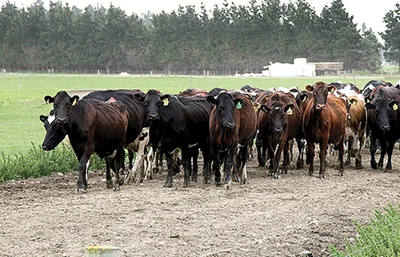
Nitrogen is the dirty word on every dairy farmer’s agenda and Government and council regulations are coming thick and fast.
But there is hope on the horizon according to Professor Keith Cameron of Lincoln University.
Lincoln University Dairy Farm (LUDF) has taken on a number of initiatives and is having positive results in reducing the amount of nitrogen leached onto its paddocks, he says.
“Here in the Selwyn Waihora catchment, we have to reduce nitrogen leaching by 30 per cent. It is a challenge.”
In grazed pasture systems most nitrate leaching occurs from the urine off the cows rather than from fertiliser.
The leaching loss from urea fertiliser is generally insignificant by comparison because it’s applied at times when it’s needed to create more pasture for the cows to eat.
A lot of the research being conducted in New Zealand is trying to find ways to reduce the nitrogen loss from the urine patch, Cameron says.
“At LUDF we use lysimeters – there are 60 spread across the farm – that collect the water and measure the nitrate concentration,” he says.
Using Italian ryegrass reduces the amount of nitrate leaching by 25 per cent compared to a perennial ryegrass/white clover mix. Italian has a lower leaching loss, the reason being that it has a higher growth rate in the late autumn when uptake from the plant is critical to reducing the risk of leaching.
Another way to reduce nitrate leaching is to use plantain, maize, or fodderbeet.
These plants can reduce the nitrogen from 700kg per hectare down to 500kg per hectare. Through the use of these plants there is a 42 per cent reduction in nitrogen leaching from the LUDF lysimeters, Cameron says.
There is a lot of research being conducted on the use of plantain to measure benefits on the farm. Study has found that perennial ryegrass/white clover mixture is higher in nitrogen, but this can be reduced by putting plantain into the pasture mix. Including plantain and Italian ryegrass combined gives an even bigger reduction.
“We can use lower input systems to reduce nitrogen leaching and still be profitable,” Cameron said.
“In the Pastoral 21 Research Programme (P21) the effect of reducing a high stocking rate of five cows per hectare down to 3.5 cows per hectare was investigated. The nitrogen fertiliser application was dropped from 400kg per hectare down to 150. The grain supplement was dropped from 800 down to 100kg per cow per year.
The important outcome was that the calculations showed there would be a reduction of 38 down to 30 kilogrammes of nitrogen per hectare leached. That is about a 30 per cent reduction.
“So what did LUDF do? It reduced the stocking rate from four cows per hectare down to 3.4 cows per hectare. That took off about 100 cows. We got the same milksolids by improving the cow’s diet. We reduced the fertiliser applied from 277kg per hectare down to 148. That gave us about a 15 per cent reduction in leaching: from 72 down to below 60,” Cameron said.
LUDF then introduced improved irrigation management and irrigation infrastructure. And these changes combined gave around about 25-30 per cent reduction in nitrate leaching, taking the farm from 72 down to about 42, and well meeting the target of 30 per cent.
One of the reasons LUDF managed this was to use soil moisture monitoring with a scheduled irrigation application.
The amount of water in the soil was measured using a system called Aquaflex which was developed at Lincoln University.
It involved a sensored tape on an angle in the ground, and that sensor was able to detect how much moisture was present in the top layer of soil.
The information from this electronic device went to an aerial which sent a signal back to the farm office where it examined the soil moisture on the farm.
“The other thing we did was improve the irrigation efficiency,” says Cameron. “We moved the centre pivot 80 metres north, we took the swing arm off the end of it and replaced it with two slower part pivots. We also introduced solar set pivots in the corners which moved away from the long line laterals. What this did was reduce the amount of excess water applied which meant that an average amount of water was reduced down to 200mm.”
When cows go to the winter grazing block they are feeding on fodderbeet or kale and we know that those systems can be leaking because urine is deposited onto the bare ground over the winter time, Cameron said.
A 30 per cent reduction in nitrogen leaching can be achieved by sowing a catch crop of oats after the cows have grazed the break of fodderbeet or kale.
Another option is to build some standoff pads. Either a wood chip base or a synthetic carpet base – but the important thing is the animals are tipped off the winter grazing block once they have had their full ration of feed. Then there are 16-18 hours on the feed pads and the drainage from these pads is collected in the effluent pond.
“On LUDF we have installed a Cleartech effluent cooling system,” Cameron said. “One of the benefits of this is that it reduces the amount of effluent requiring either storage in the pond or application to the land.
“When the cows come to the yard the effluent would normally go into the effluent storage pond, but we have intersected that, put it in a clarifying tank which treats the effluent and the top part of the tank is sent to a recycle tank to wash the yard. This means we are sending less effluent to the pond so it doesn’t fill so quickly and we don’t have to apply the effluent when the soils are wet.”
So to summarise, here we go!
Use cool-season active plants like Italian ryegrass.
Reduce the urinary nitrogen concentration coming out the rear end of the cow by having plantain in the pasture, or other feed options like high carbohydrate maize or fodderbeet.
Use a lower input system – you can reduce the inputs and still make a profit.
Lowering the stocking rate in the autumn will reduce leaching.
Improve irrigation efficiency by soil moisture managing.
Use catch crops e.g. oats, for winter forage grazing.
Use standoff pads in the winter.
Using nitrification inhibiting technology such as Cleartech as well as efficient recycling.
- By Pat Deavoll