
Tools more than talk

“A community is judged on the way it treats its weakest,” says Mid Canterbury-based mental health advocate Craig “Wiggy” Wiggins.
Wiggins’ grassroots wellbeing initiative, Lean On a Gate, may have been born during the isolation of Covid, but it’s more relevant than ever—because it’s focused on tools, not just talk.
In what has become a crowded space of mental health messages, Lean On a Gate stands out by doing more than just raising awareness, Wiggins says.
“That’s the difference with Lean on A Gate.
“We want to train people to as how to have strong communities.”
While some mental health advocates charge hefty fees to share their personal journeys, Wiggins says his approach is about community empowerment—not commercial gain.
“Rather than just charging a fee to tell our story about our own journey, we want to empower communities to be better and stronger in their own right.”
Through Lean On a Gate, a number of tools and initiatives have been created to support rural wellbeing—most notably AgriConnect.
AgriConnect equips rural professionals who are at the coal face of farming—such as agronomists, stock agents and vets—to spot the signs that someone may be struggling.
It gives them the knowledge and resources to connect people with the right help and take practical steps.
AgriConnect isn’t just a one-off event, Wiggins said.
It’s designed to spark the creation of long-term, local support networks.
“We know the rural service industries are at the fulcrum of the pressure.
“They get to see when people aren’t going so well, whether it’s a client or a colleague, and they are right in the middle of it—they see those subtle changes.”
Another key partnership for Lean On a Gate is with Clubs New Zealand.
Together, they’ve launched Club Connect—a series of events hosted in clubrooms around the country, aimed at equipping locals with the knowledge and confidence to support each other.
“There are events going on all the time with Lean on a Gate.
“People just need to keep an eye on our Facebook page and website.”
Wiggins is also a familiar face at rural events and A&P shows across the country, thanks to the Carr Family Foundation health check-up van—a mobile clinic providing free, basic health checks to the rural community.
“The health van has been amazing this year, there is a real need for that service where people can just come in, get a quick health check, and know their numbers a bit more.”
While its main focus is physical health, Wiggins says the van has opened doors for mental wellbeing too.
“When people have a bit of care given to them in a place where they are comfortable, they tend to open up inside to the van nurse, and outside to me too.”
Wiggins encourages anyone who’s worried about a neighbour, colleague or friend to take that first step and reach out.
“If you think somebody is struggling, or even if you are struggling yourself, reaching out ids the most important thing we can do.”
For more information or to find an event near you, visit: www.leanonagate.co.nz
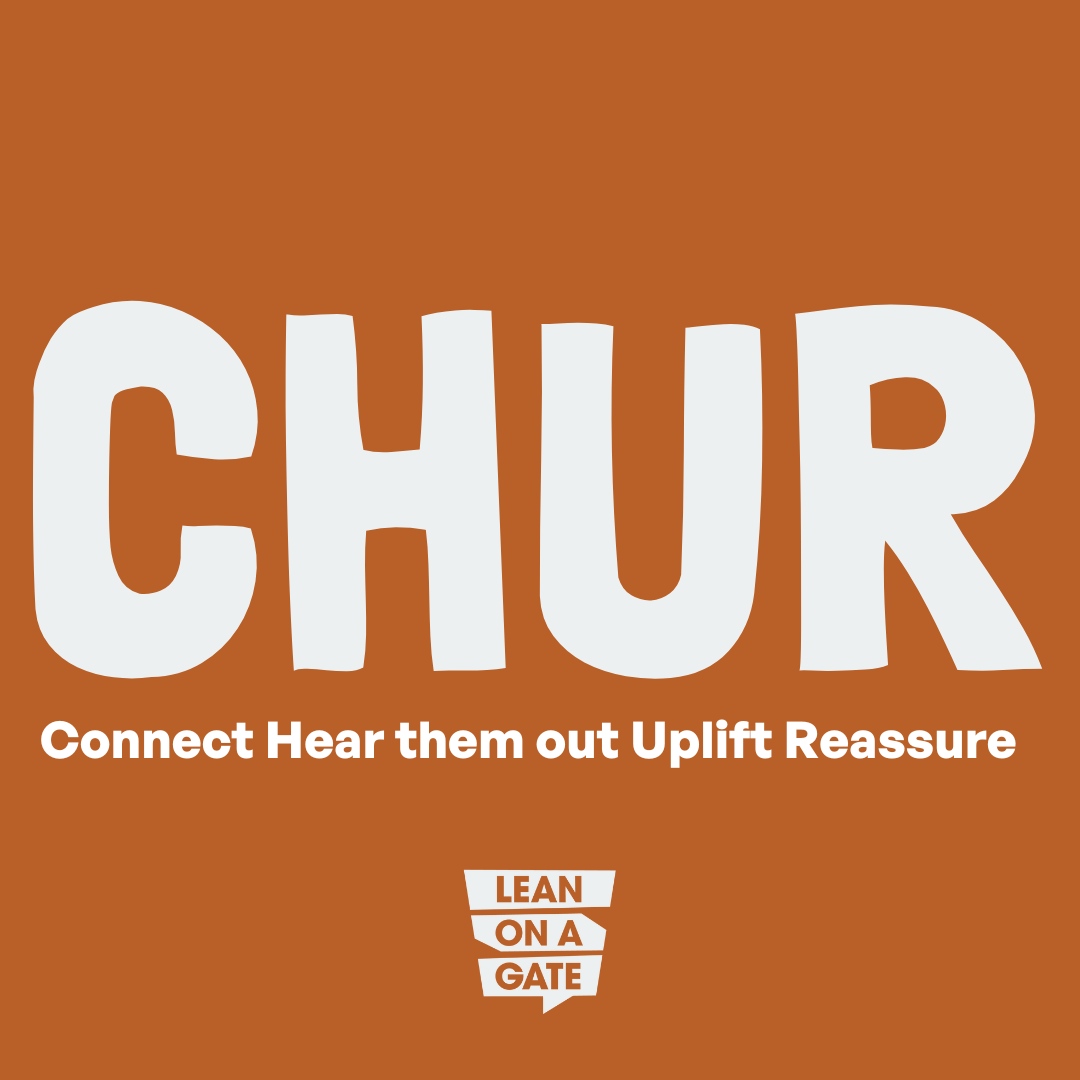
What Is the Lean On a Gate CHUR Method?
The CHUR Method is a simple, practical way to support someone who might be doing it tough. Here's what it stands for:
C – Connect: Reach out and check in—a friendly “how’s things?” can open the door.
H – Hear: Listen without judgment. Sometimes being there is all they need.
U – Uplift: Share a kind word or a small act of support. Little things can lighten a heavy load.
R – Reassure: Remind them they’re not alone and help them find the right support if needed.
A simple chat can change someone’s day—or even their life. So next time you’re wondering how to help, just CHUR.
By Claire Inkson