From bark to billions

It starts with a trailer and some bark and a conversation.
It was 2002, and Andrew Wilson was working out the back of his yard in an industrial area near the tip in Ashburton when a familiar face pulled up and changed the direction of his working life.
“At that time, my wife and I owned a little landscape supply business called Wilson’s Garden Makers and we had owned it for six years,” Wilson said.
“But one day David Street, who was at the building society, drove in with his trailer looking, theoretically, for some garden products. And then he said there was a lending role going.”
Wilson had worked in finance previously, but he and wife Ann-Marie had built their landscape business up, though it had reached that point many small operations do.
“The timing was right with the garden-making side of things because it was either time to employ more people or spend a bit more. And, from a family perspective, things had changed as well with kids arriving.
“So, everything was up in the air and then suddenly this came out of the blue.”
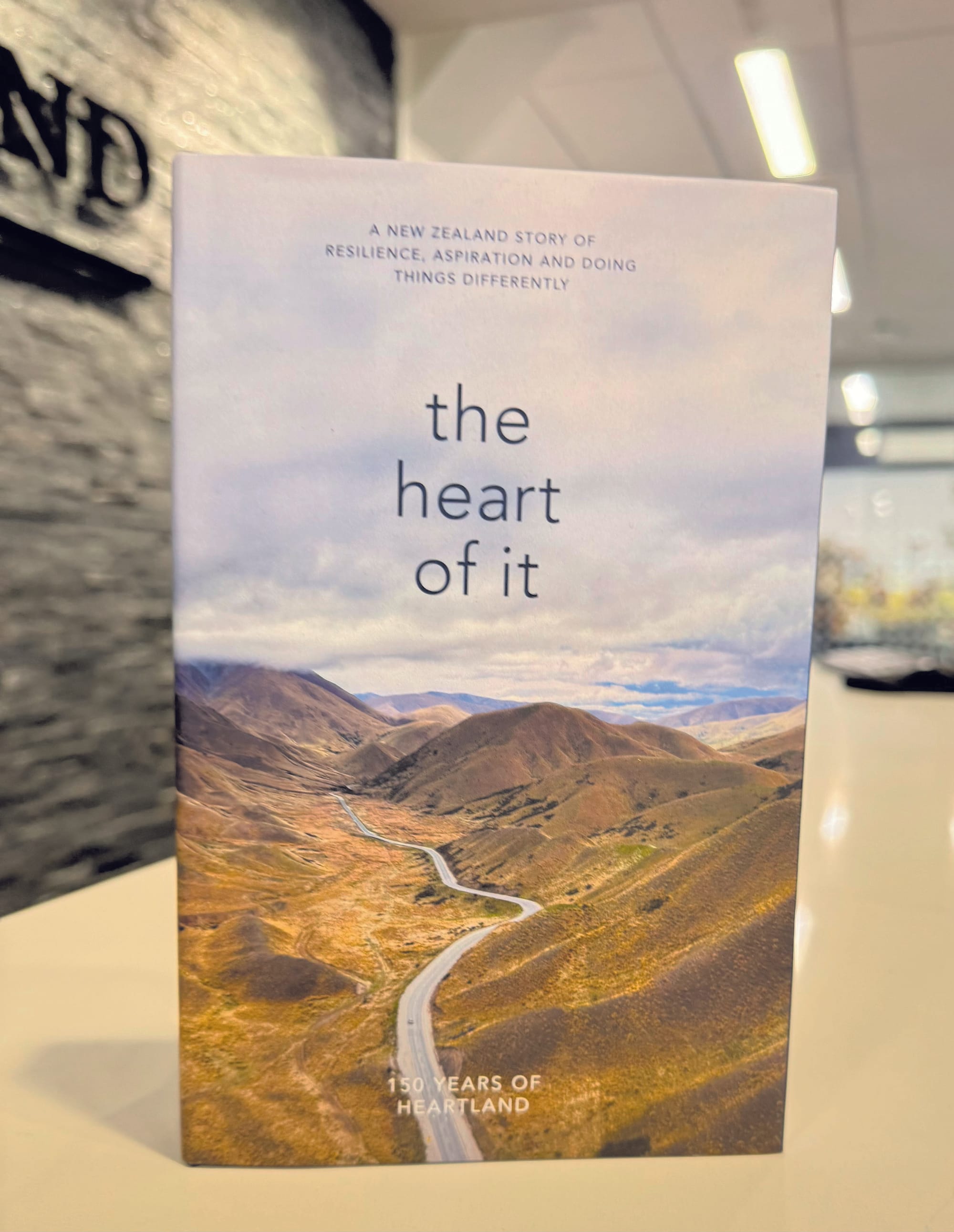
More than two decades on, and as the now multi-national Heartland Bank celebrates its 150th sesquicentennial since those foundational beginnings in Ashburton, that moment still sits at the centre of how Wilson sees the job.
Because 24 years on from that conversation over bark in his yard, the lessons from running his own business still sit at the centre of how he approaches lending now for the Ashburton Heartland Bank as its manager, while also overseeing the southern region down to Invercargill.
“Being in business, it gave me an insight into how a business should run and what a small business is up against,” he said.
“From a banking perspective, that’s very good knowledge to have.”
And what he stepped into back then was the Ashburton Building Society, a locally run organisation trading as ABS Canterbury, which had been part of the district for generations, lending money to help people into homes and backing small businesses trying to get established.
Customers were known by name, and decisions were made by people who understood the town, the farms and the businesses they were dealing with.
And now the 150th milestone, which Wilson rightly says is “certainly not to be sneezed at”, has been marked locally in a way that feels true to the place. Ashburton staff watched a short film tracing the history, shared a few drinks, enjoyed some nibbles, and took a moment to reflect on something that has quietly been part of the district for a century and a half.
“We’ve had a few cakes lately,” Wilson joked.
It sounds simple, but behind that sits a story that goes back to 1875, when the Ashburton Permanent Building and Investment Society first opened its doors, recording just $466 in mortgage lending in its first year.
And now, after a series of mergers and restructures that culminated in the creation of Heartland Bank in 2011, that lending book now sits at more than $7 billion, spread across households, farms and businesses on both sides of the Tasman.
It’s backed by more than 13,000 shareholders and serves more than 185,000 customers across New Zealand and Australia, but the line back to those early days is still easy to trace.
“We’ve gone from a locally founded building society, then a national specialist bank, and now we’ve gone trans-Tasman where we went and bought an Australian bank.
“It’s been quite amazing.”
Indeed, but for all the growth, acquisitions and expansion across the Tasman, Wilson believes the bank has held on to the values that helped build it, and ones he noticed immediately on his return.
“Coming back into the local building society was coming into an organisation where staff and customers were very welcoming. When you are working here and dealing with the locals, you’re always there to help them, and that’s still the case.”
That model carried for more than a century, but from 2005 onwards the environment had changed, with tighter regulation and stronger competition from larger banks making it harder for smaller building societies to operate on their own.
For Wilson, the moment that really defined that shift was a vote. It was November 2010 when Canterbury Building Society shareholders gathered at the Ashburton Event Centre to decide whether they would be part of a merger to create a new national bank, a decision that would shape the future of the organisation.
“There’s a couple of us here who remember that vote to say whether the Heartland merger should go ahead.
“And that was crucial, that pretty much finalised it.”
If the vote had gone the other way, the organisation may’ve remained small or struggled to compete in a changing market. Instead, it cleared the path for the formation of Heartland Bank in 2011, bringing together a number of regional lenders into a single institution with the scale to grow.
From just over $400 in its first year, it now manages billions across both sides of the Tasman, and in 2024 it took another step again, becoming the first New Zealand bank to buy an Australian bank when it purchased Challenger Bank, now Heartland Bank Australia.
But Wilson doesn’t necessarily measure success in those terms.
“The thing that has stayed the same is our service to the locals.
“We need to give good service, and we need people to notice that and to bring their mates back to us.
“That’s been a constant.”
That local focus is obvious in Ashburton with about 20 staff in the branch, which now combines a retail banking floor where people can walk in and sit down with someone, a call centre handling customers from across the country, and roles supporting Heartland Bank Australia’s operations.
It gives the Ashburton branch a reach far beyond what its founders could have imagined, but it remains deeply connected to the community where the story started.
And for Wilson, that balance matters because it’s growth without losing the culture that shaped it, and it’s also kept him invested.
“To a degree, the various changes have kept the brain going for me and it’s why I haven’t looked to go elsewhere.
“In Heartland, I’ve worked through four name changes, and we’re evolving constantly. I haven’t needed to go somewhere else because Heartland has constantly provided that challenge for me.”
Looking back, it also hasn’t been a straight-line transformation, more a series of decisions and moments that have built on each other over time.
Wilson has seen the points where things could have gone differently, where the future of the organisation wasn’t certain. But like most long stories, it’s not only those big moments that define it, as much as the smaller ones, too.
A conversation. A decision. A chance meeting that doesn’t seem like much at the time.
Or, in Andrew Wilson’s case, a trailer pulling into a yard in Ashburton to collect some bark. Or so he thought.
By Daryl Holden