
“You can’t be green if you are in the red"

It’s been said before, but coming from Sir Graeme Harrison it packs a punch.
He’s spreading the message on behalf of farmers who don’t have his resources to invest in environmental initiatives.
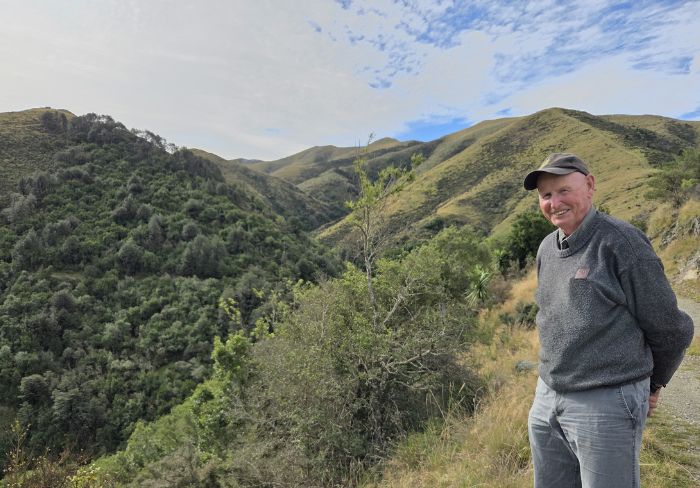
Sir Graeme owns Mt Alford Station in the Mid Canterbury foothills and is a founding member of the Foothills Catchment Group.
Since purchasing Mt Alford 10 years ago, the 76-year-old has been on a mission to enhance and grow native bush, tussock, and wetland areas on his hill-country station.
He subscribes to Clint Eastwood’s advice on ageing; “Never let the old man in.”
Mt Alford Station contains challenging country.
An extinct volcano and fault line run through the property, and it contains the headwaters for Pudding Hill Stream and the North Branch of the Ashburton River.
In 2021, large floods wiped out infrastructure and sections of native planting corridors he had established along the river. With New Zealand’s most reliable ski field Mt Hutt next door, the station’s slopes are wet and cold much of the year. Wild deer are a problem visiting from neighbouring properties and Hakatere Conservation Park.
Farming intensification is tempered by conditions attached to being the source water supply for Methven township.
Rational optimist
In the 1960s the land was pretty bare with pockets of remnant bush. By the 1980s, much of Mt Alford was burnt off and regenerating natives emerged in the 1990s.
Previously dominated by exotic forestry, Sir Graeme now mixes it up with areas of natives interspersed amongst beef and sheep production. He describes himself as a rational optimist.
“I’ve arrived at optimism after looking at all the evidence.”
His biggest bugbear is bureaucracy and inflexible doctrines.
Growing Mt Alford’s biodiversity hasn’t been easy when faced with officials telling him what he can and can’t do. He endorses a viewpoint put forward by ecologist Chris Thomas that mixing exotics and natives produces stronger biodiversity.
Too many environmentalists are purists and Sir Graeme has no time for that. He’s planning for a longer timeframe.
“It’s illogical to only use remnants.
“When you are dealing with a landscape that is as ancient as this one, you apply a 50-year timeline for infrastructure.
“We have completely re-pastured the farm but when it comes to nature reforestation we are talking a 1000-year view.”
Listening to esteemed ecologist Dr David Norton on Radio New Zealand a few years ago seeded his strategy.
“He was talking about areas of natives inside exotics.
“I came home and found online his research and that’s what we are doing.”
Pinus Radiata has been removed from former forestry blocks that are wet and wind traps.
Douglas Fir has been retained as it sequesters 40 tonnes of carbon annually and does exceptionally well in the high rainfall climate.
Sir Graeme closed off areas to livestock to recharge carex secta, protect Podocarp and Broadleaf remnants and a 33ha montane reserve, and created three red tussock wetland areas where only sheep graze.
All up 376.6ha of the 2300ha farm is now regenerating with more than 48ha in protected wetlands. Seed is collected and propagated by the Wai-ora Nursery in Christchurch.
Many parts of the farm now no longer need planting as the bush itself is taking over.
Pest and predator control
Protecting what is there, and adding to it, means tackling pests.
Removing broom and gorse, wilding pines, holly and sycamore, and animal pests like deer and pig is “a never-ending battle”.
Much of this is done by hand like removing Tutu (poisonous to cattle) and the maintenance of 150 wasp baiting stations.
Last year 1193 possums, 316 deer, 48 pigs and 31 goats were taken out.
Over the past decade the possum tally topped 6500.
Members of his farm team, who enjoy hunting, are the recipients of bounty.
“We put in a processor/chiller facility to help motivate the team.”
Over the last decade, Sir Graeme has put up to 10,000 natives each year into the ground at an annual cost of approx $100,000, and he’s seeing the results.
“Make no mistake about it, the birds are here. They are coming.”
More than 40 different species have been sighted including Kereru, New Zealand falcon and his beloved Bellbird.
All this comes at a cost, not just capital and labour, but opportunity cost.
Sir Graeme has bought neighbouring land to provide more flat areas for production.
“The viability of the farm has been challenged by not having more finishing land.”
He is conscious his efforts are beyond the reach of many farmers, and says we need to simplify environmental investments.
“We have got to make it easier and incentivise it.”
There are ongoing issues with the regulatory environment.
Putting 252km of fencing, including boundary deer fencing where possible, across the property has been expensive and DOC didn’t have funds to contribute.
Consent to farm required by Environment Canterbury cost in excess of $20,000.
Low slope designations caused headaches and zoning restrictions under the district plan strangled plans for accommodation in special parts of the farm.
While Sir Graeme’s vision is very much his own, being part of a catchment group with other farmers has been valuable.
Getting together with his neighbours, joining field days, accessing information and listening to speakers, helps cement he is on the right path.
Collaboration
After years of working in the notoriously difficult meat industry (founder and former chairman of ANZCO Foods), Sir Graeme is convinced the way forward relies on working together.
“Out of all the major sectors in New Zealand the meat industry is the tough one.
“I used to have to deal with pretty challenging circumstances and collaboration is the best, not confrontation. Joining together and collaborating is what I believe in.”
“Practical environmentalists are pragmatic and want to enjoy their land.
“We are looking at what is already there on the farm and trying to work out what will survive.
“It depends on the variety and species. It is hit and miss but you learn from your misses.”
Sir Graeme believes beef and sheep farmers along the Canterbury Foothills have the most potential to unlock further biodiversity gains for the region.
Getting them enthused and working together will yield the greatest benefits.
“We are very much guardians of a pristine environment.”
Footnote
The Foothills Catchment Group continues to build on the water quality data set they started three years ago. Native planting projects have spurred on neighbourly collaboration, particularly around Staveley, and is ongoing. The Foothills Catchment Group are members of Mid Canterbury Catchment Collective (MCCC), and are one of 10 catchment groups to establish in our district since 2021.
By Janine Holland, [Mid Canterbury Catchment Collective communication contributor]